Short answer: your first year freelancing is not just about filing a return next April. It is about building a system now: track every payment, save proof for business expenses, review whether estimated taxes are required, and turn the year into a clean Schedule C packet.
The IRS says self-employed individuals generally file an annual return and pay estimated taxes quarterly. It also says gig income can be taxable even when it is not reported on a 1099. That means the safest first-year move is to keep your own records instead of waiting for forms to tell you what happened.
This guide is written for U.S. freelancers, independent contractors, solopreneurs, and part-time gig workers who are new to 1099-style income. It is general education, not personalized tax advice. Use it to get organized, then involve tax software or a qualified tax professional for your specific return.

Scan receipts, add business notes, categorize expenses, and keep records ready for tax season from your first freelance payment onward.
TL;DR: First-Year Freelancer Taxes
- Open a separate place to receive freelance income and pay business expenses.
- Record every payment, even if no client or platform sends a 1099.
- Capture receipts as soon as you spend money for the business.
- Categorize expenses monthly instead of reconstructing them in April.
- Use Form 1040-ES, software, or a tax professional to review estimated tax needs.
- Save confirmation numbers for every estimated tax payment.
- Build a January filing packet with income, expenses, 1099s, and open questions.
First-Year Freelancer Tax Checklist
Treat this as a year-one operating checklist. You do not need a complex accounting department. You need a repeatable habit that captures the evidence your future tax return depends on.
| When | What to do | Why it matters |
|---|---|---|
| Week 1 | Separate freelance income, expenses, and tax savings. | Cleaner records reduce personal/business confusion. |
| First payment | Record client, amount, invoice, date, and payment method. | Taxable income may need reporting even if a 1099 never arrives. |
| Every expense | Save receipt, category, and business purpose note. | A receipt without context may not explain the deduction. |
| Monthly | Reconcile income, categorize expenses, and flag questions. | Small monthly cleanup beats tax-season reconstruction. |
| Quarterly | Review Form 1040-ES or talk to a tax pro about estimates. | Estimated taxes are pay-as-you-go, not just April paperwork. |
| January | Collect 1099s, export summaries, and verify totals. | Tax forms should confirm your records, not replace them. |
What Changes When You Become a Freelancer?
The big shift is withholding. In a W-2 job, an employer generally withholds tax from each paycheck. In freelance work, clients often pay you without withholding. You may receive a 1099, but the form is not a complete bookkeeping system.
The IRS describes self-employed people as sole proprietors, independent contractors, partners, or people otherwise in business for themselves. It also explains that self-employed individuals generally pay both income tax and self-employment tax, with Schedule C and Schedule SE commonly involved for sole proprietors.
Your first-year goal is not to become a tax expert. It is to avoid the classic beginner problem: realizing in March that you have income in three apps, receipts in five places, no mileage log, and no clear answer for whether you should have made estimated payments.
Set Up Your Tax System Before Tax Season
A good freelancer tax system has five parts: income records, expense records, receipts, tax payment records, and a place for questions. Keep it simple enough that you will actually use it after a busy client week.
- Create a dedicated money trail. A separate bank account or card can make business activity easier to review, even if you remain a sole proprietor.
- Choose expense categories. Start with practical categories such as software, supplies, phone/internet, education, travel, meals, advertising, professional services, and equipment.
- Capture receipts immediately. If you wait until filing season, faded receipts and missing business context become harder to defend.
- Keep a tax questions list. Do not guess on home office, vehicle, startup costs, or mixed personal/business purchases. Flag them for tax software or a professional.
The First-Year Difference: Build a Proof Chain
Most freelancer tax advice starts with forms. Forms matter, but they come late in the process. Your first-year advantage is building a proof chain while transactions are happening.
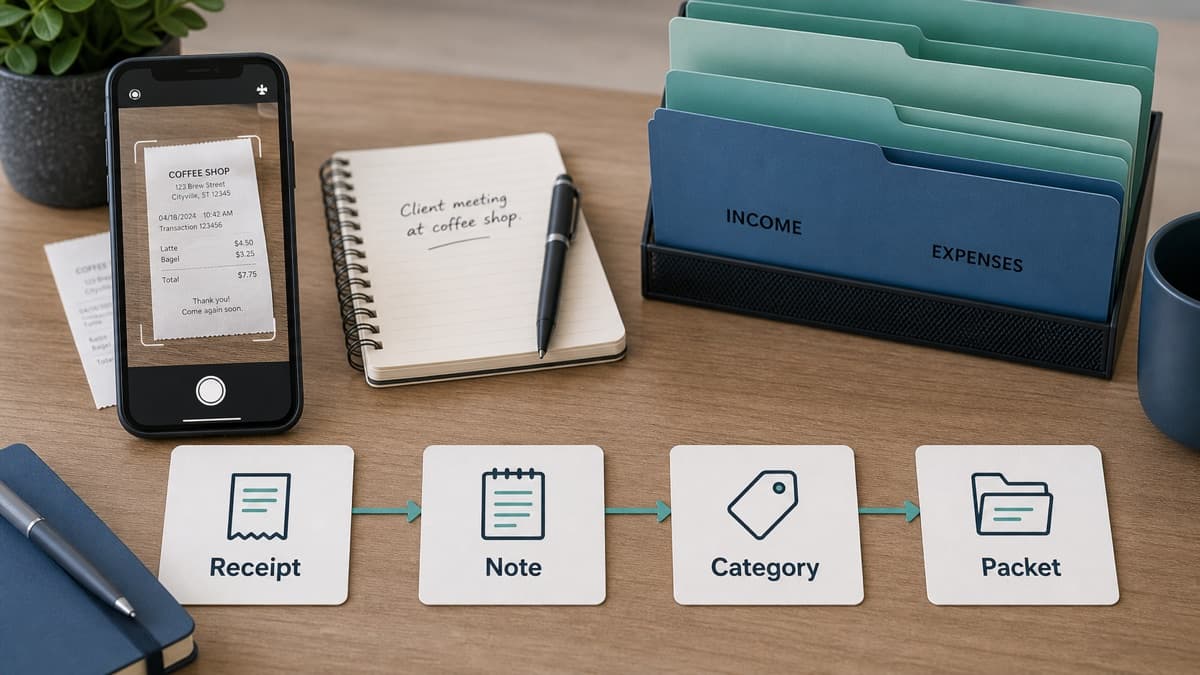
A proof chain connects four things: the client or project, the payment or purchase, the business reason, and the record that supports it. For income, that could be invoice plus bank deposit. For an expense, it could be receipt plus card charge plus a note explaining which client, project, or business activity it supported.
TaxLens helps with the recordkeeping part of that chain: scanning receipts, adding notes, and keeping business expenses searchable. It does not decide whether a deduction is allowed, calculate your tax liability, or replace professional advice. That boundary matters because tax outcomes depend on your facts. For a deeper operating system, see our guide on how to track business expenses as a freelancer.
Track Income, Even Without a 1099
The IRS Gig Economy Tax Center says income can be taxable even if it is part-time, temporary, paid in cash, or not reported on an information return. That point matters for first-year freelancers because beginners often wait for tax forms instead of maintaining a revenue log.
Your income tracker should include client or platform name, invoice number, service period, payment date, gross amount, fees withheld by the platform if visible, and notes for refunds or chargebacks. If you use multiple payment channels, reconcile them monthly against your bank deposits.
If a 1099 arrives in January, compare it with your own records. If a 1099 does not arrive, do not assume the income disappeared. Your return should be based on the income you actually earned and received under the applicable rules.
Track Deductible Expenses and Receipts
First-year freelancers usually focus on finding deductions. The better focus is proof. For each expense, save the receipt or invoice, the payment record, the business purpose, and any allocation if an item is partly personal.
Start with ordinary categories: tools and software, office supplies, professional education, advertising, payment processing fees, subcontractor costs, phone and internet, business travel, business meals, equipment, and professional services. For deeper deduction ideas, read our guide to freelancer tax deductions.
If you are unsure whether a receipt is required for a specific category, separate that question from the habit of keeping records. Our guide to deductions without receipts explains why "no receipt" is not the same as "no proof."
| Expense category | Common examples | Records to keep |
|---|---|---|
| Software and subscriptions | Design tools, accounting apps, cloud storage, scheduling tools | Invoice or receipt, renewal email, business purpose note |
| Office and supplies | Notebook, printer ink, desk accessories used for work | Itemized receipt and note if the purchase is mixed-use |
| Phone and internet | Business portion of phone, internet, hotspot, work SIM | Bills, allocation method, and reason the business portion is reasonable |
| Education | Courses, books, workshops tied to your freelance work | Receipt, syllabus or description, and connection to your business |
| Travel and meals | Client trip, conference, business meal, parking, rideshare | Receipt plus date, place, people involved, and business purpose |
| Professional services | CPA, attorney, bookkeeper, contract review, business insurance | Invoice, engagement letter, and payment record |
The 15-Minute Monthly Freelancer Tax Routine
The best first-year tax system is boring and repeatable. Put one recurring calendar block near the end of every month and run this mini-review before the details get stale.
| Time | Task | Output |
|---|---|---|
| 5 minutes | Match deposits to invoices and client payments. | Income log is current. |
| 5 minutes | Scan or upload any missing receipts and add business purpose notes. | Expense evidence is attached while memory is fresh. |
| 3 minutes | Categorize uncategorized transactions. | Schedule C categories are mostly ready. |
| 2 minutes | Write down tax questions before you forget the context. | A clean list for software, CPA, or enrolled agent review. |
Copyable monthly review note
Month:
Income reconciled:
Missing invoices:
Uncategorized expenses:
Receipts missing business purpose:
Estimated tax question:
State/local tax question:
Items to ask a tax professional:
Plan for Estimated Taxes
Estimated tax is how many freelancers pay tax during the year because clients usually do not withhold federal income tax, Social Security, or Medicare tax from freelance payments. The IRS estimated tax page says taxes must be paid as income is earned, either through withholding or estimated tax payments.
Do not rely on a generic percentage from social media. First-year estimates can be messy because your income may rise, fall, or arrive in uneven client cycles. Use Form 1040-ES, tax software, or a qualified tax professional to update your estimate as the year changes.
Save payment confirmations in the same place as your income and expense records. At filing time, you need to know how much you already paid and when you paid it.
Know the Forms: Schedule C, Schedule SE, 1099-NEC, and 1040-ES
| Form | What it does | First-year note |
|---|---|---|
| Schedule C | Reports sole proprietor business income and expenses. | Your monthly records should become the Schedule C summary. |
| Schedule SE | Calculates self-employment tax when applicable. | Self-employment tax is separate from regular income tax. |
| 1099-NEC / 1099-K / 1099-MISC | Information returns that report certain payments. | Use them to verify income, not as your only income tracker. |
| Form 1040-ES | Worksheet and vouchers for individual estimated tax. | Review it when freelance income is not covered by withholding. |
The IRS Self-Employed Individuals Tax Center is the best starting point for official form context. If you pay other freelancers or contractors in your own business, also review information return rules separately because payer obligations are not the same as recipient income reporting.
First-Year Freelancer Tax Calendar
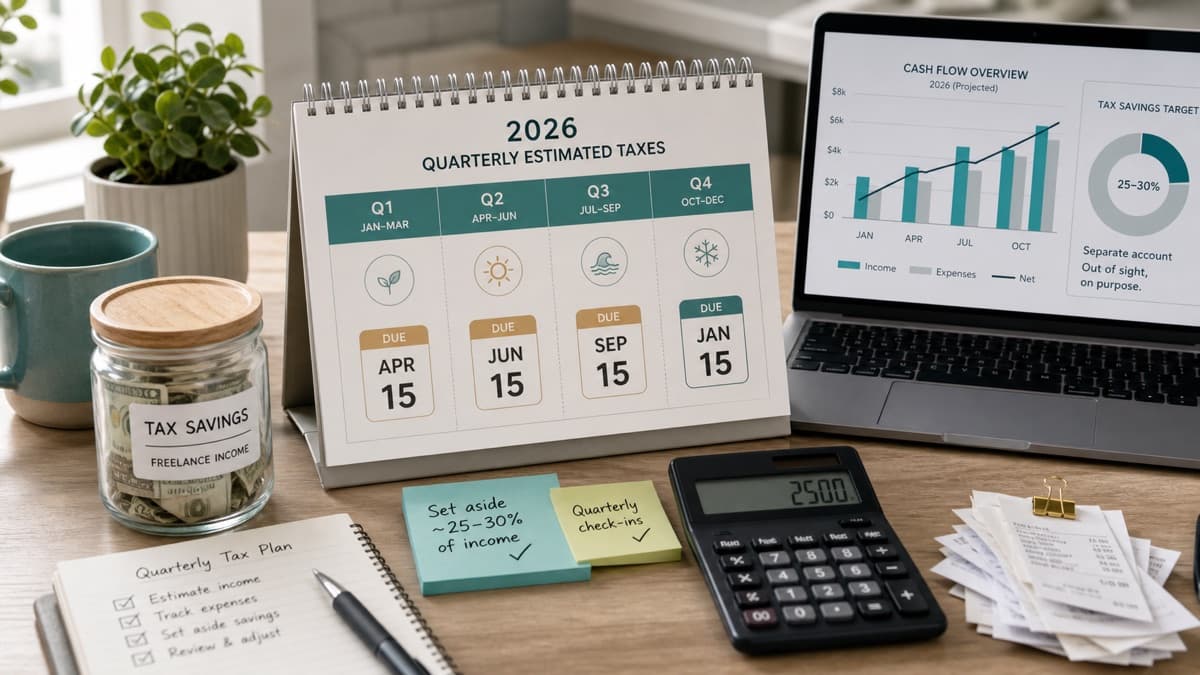
For 2026 calendar-year taxpayers, IRS Publication 505 lists the following federal estimated tax periods and due dates. State deadlines, fiscal-year calendars, weekends, holidays, disaster relief, and January filing exceptions can change what applies to you.
| Income period | Federal due date | First-year action |
|---|---|---|
| Jan. 1 - Mar. 31, 2026 | Apr. 15, 2026 | Review Q1 profit, update your estimate, and make the first payment if required. |
| Apr. 1 - May 31, 2026 | Jun. 15, 2026 | Recalculate after spring income changes; do not assume Q1 was still accurate. |
| Jun. 1 - Aug. 31, 2026 | Sep. 15, 2026 | Catch up your books before fall projects make the year harder to reconstruct. |
| Sep. 1 - Dec. 31, 2026 | Jan. 15, 2027 | Pay the fourth estimate unless an exception applies, then prepare your filing packet. |
Build Your January Filing Packet
By January, the job is not to start bookkeeping. The job is to package the year clearly so filing is a review process. Use this packet before you open tax software or send documents to a preparer.
- Total freelance income by client, platform, and payment method.
- Copies of 1099-NEC, 1099-K, 1099-MISC, or other income forms received.
- Expense summary by category, with receipts available for review.
- Mileage log or vehicle records if you drove for business.
- Home office measurements and support if you may claim a home office.
- Estimated tax payment dates and confirmation numbers.
- Prior-year return, W-2 income, or spouse income details if relevant.
- Open questions for tax software, a CPA, or an enrolled agent.
Copyable January filing packet index
1. Income summary
- Total by client/platform:
- 1099 forms received:
- Income not on 1099:

2. Expense summary
- Total by category:
- Large purchases:
- Mixed-use items needing allocation:

3. Tax payments
- Estimated tax payment dates:
- Confirmation numbers:
- State/local payments:

4. Review questions
- Home office:
- Vehicle/mileage:
- Startup costs:
- Retirement/health insurance:
- Anything unusual:
Common First-Year Freelancer Tax Mistakes
Waiting for 1099s to track income. Tax forms may arrive late, contain errors, or not arrive at all. Your income log should exist before January.
Mixing every purchase in one personal account. Mixed accounts are not automatically fatal, but they make review harder and increase the chance that deductible business expenses are missed.
Saving receipts without business context. A lunch receipt, software subscription, or travel purchase needs a business purpose. Add notes while the context is fresh.
Ignoring estimated taxes until April. The IRS estimated tax system is designed around paying during the year. Review it as soon as freelance profit becomes meaningful.
Copying someone else's deduction list. Deductions depend on your work, facts, and records. Use lists as prompts, then document what actually applies to your business.
Forgetting state and local tax. This article focuses on federal basics. Your state or city may have separate filing, payment, or business registration requirements.
When to Call a Tax Professional
Many first-year freelancers can start with tax software and organized records. A professional becomes more valuable when your facts stop being simple.
- You left a W-2 job midyear and are unsure how withholding and estimates interact.
- You bought expensive equipment or have startup costs from before launch.
- You work in multiple states or moved during the year.
- You have business losses, inventory, employees, or subcontractors.
- You want advice on entity structure, retirement plans, or health insurance deductions.
- You received an IRS or state tax notice.
FAQ
Do I have to pay taxes in my first year freelancing?
Yes, if you have taxable freelance income, you generally need to report it on your federal tax return. The IRS says self-employed people generally file an annual return and may need to make estimated tax payments during the year.
Do I need to report freelance income if I do not get a 1099?
Yes. A 1099 is an information form, not the source of your tax obligation. The IRS says gig and freelance income can be taxable even when it is not reported on a 1099, so keep your own income records.
What forms do first-year freelancers usually need?
Many sole proprietor freelancers report business income and expenses on Schedule C, calculate self-employment tax on Schedule SE, and use Form 1040-ES during the year if estimated payments are required. Your exact forms depend on your facts.
When are 2026 estimated tax payments due?
For calendar-year individuals, IRS Publication 505 lists 2026 estimated tax due dates as April 15, 2026; June 15, 2026; September 15, 2026; and January 15, 2027, with special rules for weekends, holidays, fiscal-year taxpayers, and some January filers.
How much should a first-year freelancer save for taxes?
There is no one-size-fits-all percentage because federal income tax, self-employment tax, deductions, credits, state tax, and other income all matter. A safer first-year habit is to separate tax money from spending money and use Form 1040-ES, tax software, or a tax professional to update estimates as income changes.
What records should I keep as a freelancer?
Keep income records, invoices, payment confirmations, bank statements, categorized expenses, receipts, mileage logs if you drive for business, home office support if claimed, and records of estimated tax payments. The goal is a clean Schedule C packet, not just a pile of receipts.
Can I deduct expenses from before my first client paid me?
Possibly, but startup costs and pre-opening expenses can be fact-specific. Keep records, note the business purpose, and ask a tax professional before claiming expenses from the period before your business was active.
Should I hire a tax professional in my first freelance year?
Consider it if you have multiple income streams, large equipment purchases, business losses, employees or subcontractors, state tax complexity, prior-year withholding issues, or uncertainty about estimated tax. Even one planning session can help prevent first-year mistakes.
The First-Year Rule: Build the Habit Before You Need It
Your first freelance tax year does not need to be chaotic. Track income when it arrives, scan receipts when you spend, review estimates during the year, and build a January filing packet before tax season pressure starts.
TaxLens is built for that habit: quick receipt capture, expense notes, categorization, and organized records that are easier to review when it is time to file.
Scan receipts, add business notes, categorize expenses, and keep records ready for tax season from your first freelance payment onward.
Editorial note: This guide was prepared by the TaxLens Editorial Team and reviewed for federal tax workflow accuracy in May 2026. It is educational content for U.S. freelancers and does not replace advice from a CPA, enrolled agent, attorney, or other qualified tax professional.
Sources reviewed: IRS Self-Employed Individuals Tax Center, IRS Estimated Taxes, IRS Publication 505, IRS Gig Economy Tax Center, and IRS Form 1099-NEC FAQ.